

In April 2025 we published a technical guide to AI agent development: what an agent is, the classic taxonomy, the architectural building blocks, and a worked example of a marketing agent built on n8n and OpenAI. The fundamentals in that article still hold. Almost everything around them has changed.
Seventeen months later, agents are no longer a demo category. The tool-connection problem has a standard (MCP). The agent-to-agent problem has a standard (A2A). Every major lab ships its own agent SDK. Evaluation went from "does it look right" to benchmark suites and production tracing. And the frameworks we recommended in 2025 have either been rebuilt or absorbed into something else.
So this is the same guide, rewritten for how agents are actually built in September 2026. If you read the original, skim the first two sections and slow down from "Architecture" onward.
Core Characteristics of AI Agents
An AI agent is a computational system that perceives its environment, reasons about it, and acts autonomously to achieve a goal. That definition has not moved, and neither have the six traits that separate an agent from a rule-based automation.
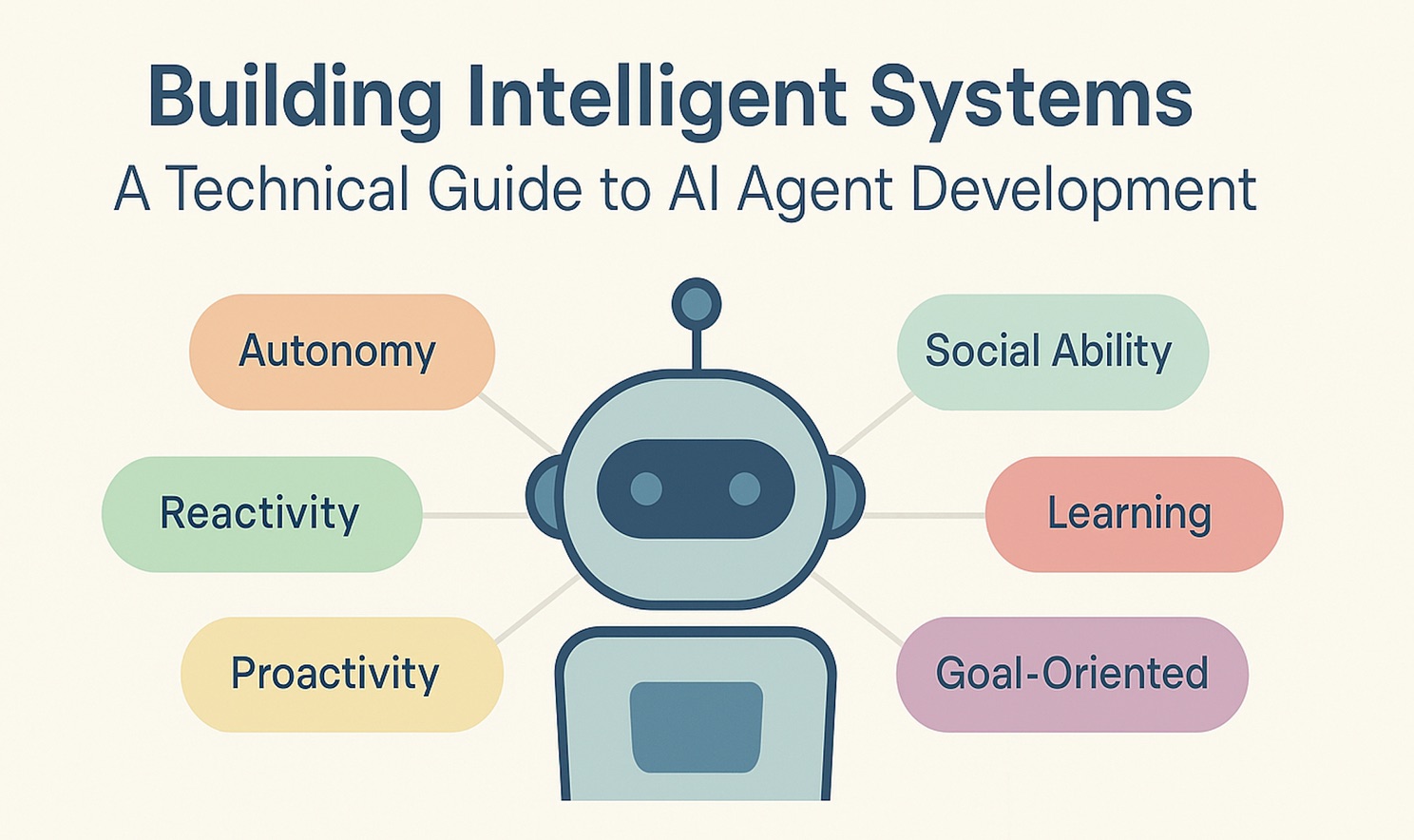
- •Autonomy: operates without step-by-step human instruction.
- •Reactivity: senses and responds to changes in its environment.
- •Proactivity: initiates action toward its goals rather than waiting to be asked.
- •Social ability: interacts with humans, systems, and — increasingly — other agents.
- •Learning: improves with experience.
- •Goal orientation: every action is in service of a defined objective.
What changed in practice is how "learning" shows up. Very few production agents learn online in the reinforcement-learning sense. Instead, the learning loop runs through evaluation: traces are collected, scored, and fed back into prompts, tool definitions, and routing rules on each release. The agent gets better; it just does so on a deployment cadence rather than a per-interaction one.
Types of AI Agents
The classic taxonomy from the AI textbooks is still the clearest way to reason about what you're building.
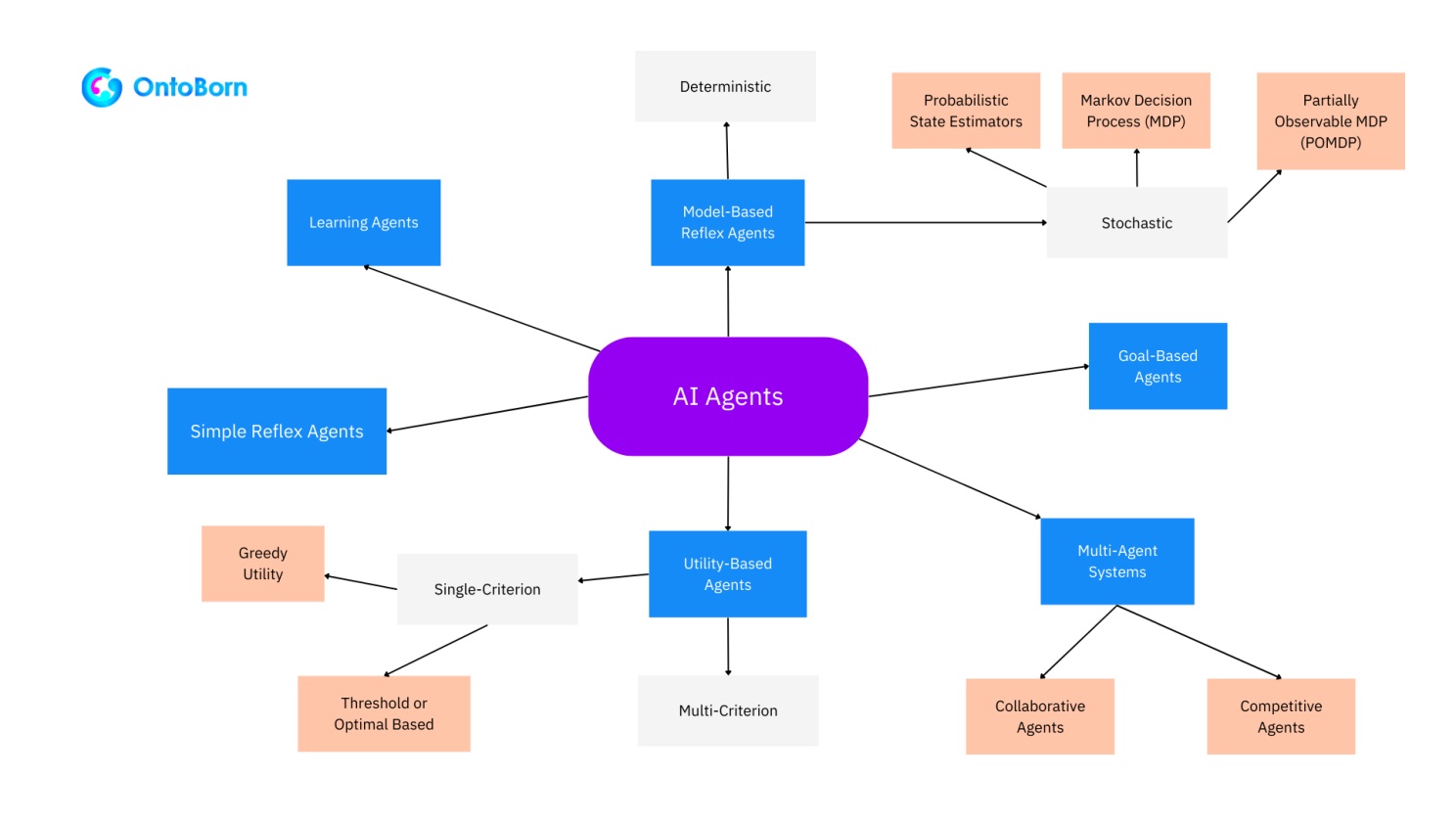
- •Simple reflex agents act on current input with fixed rules. No memory, no adaptation.
- •Model-based reflex agents maintain an internal model of the world so they can act sensibly in environments they cannot fully observe.
- •Goal-based agents plan sequences of actions toward an explicit objective.
- •Utility-based agents go a step further and optimise among possible outcomes using a utility function.
- •Learning agents include a component that improves performance over time.
- •Multi-agent systems coordinate several agents, cooperatively or competitively.
Mapped onto 2026 practice: almost every production LLM agent is a goal-based agent with a model-based memory layer, wrapped in an evaluation loop that makes it a learning agent at the system level. Multi-agent systems, which were mostly research in 2025, are now routine — the "orchestrator plus specialised sub-agents" pattern is the default for anything beyond a single well-bounded task.
Architectural Components in 2026
The five components from our original article — perception, reasoning, planning, action, memory — remain the skeleton. But the industry has converged on concrete implementations for each, and two components that were optional in 2025 are now mandatory.
| Component | 2025 practice | 2026 practice |
|---|---|---|
| Perception | Custom API integrations per data source | MCP servers expose tools, data, and prompts through one protocol; agents discover what's available at runtime |
| Reasoning | Chat-completion models with chain-of-thought prompting | Dedicated reasoning modes in every frontier model; thinking budget is a tunable cost/quality lever |
| Planning | Prompt-level "think step by step"; some MDP-style planners | Explicit graph or handoff orchestration (LangGraph, Agents SDK handoffs) so plans are inspectable and resumable |
| Action | Function calling via provider-specific schemas | Standardised tool calling over MCP, with schema validation and automatic retries in the runtime |
| Memory | Vector DB for RAG; Airtable-style logs | Layered memory: 1M-token context windows for working memory, vector/graph stores for long-term recall, and persistent memory files for cross-session continuity |
| Guardrails (new) | Ad-hoc validation nodes | Permission tiers, policy checks, and human-in-the-loop gates as first-class runtime features |
| Observability (new) | Logging if you remembered to add it | Trace-level instrumentation (OpenTelemetry-compatible) with evals attached to spans |
Two more shifts deserve a sentence each:
- •Agents now talk to agents. Google's Agent2Agent (A2A) protocol, donated to the Linux Foundation in 2025, gives agents a standard way to discover each other's capabilities and delegate work. MCP handles agent-to-tool; A2A handles agent-to-agent. Both now live under the Linux Foundation's Agentic AI Foundation, co-founded by OpenAI, Anthropic, Google, Microsoft, AWS, and Block.
- •The runtime does more of the work. In 2025, retries, schema validation, rate limiting, and context management were things you built. In 2026, they are things you configure.
Tools and Frameworks
Our 2025 list was TensorFlow, PyTorch, LangChain, and AutoGPT. Two of those are deep learning libraries you'd use to train a model, not build an agent; one has been superseded by its own successor; and AutoGPT is a historical footnote. Here is the list a team would actually choose from today.
| Framework | Vendor | Style | Best for |
|---|---|---|---|
| LangGraph | LangChain | Graph-based, stateful | Auditable multi-step workflows with checkpoints and rollback; the current production standard for complex agents |
| OpenAI Agents SDK | OpenAI | Model-driven loop with handoffs | Fast path to multi-agent systems on OpenAI models; replaced the experimental Swarm |
| Claude Agent SDK | Anthropic | Model-driven loop, MCP-native | Reliability-focused agents with strong error handling and built-in tool permissions |
| Google ADK | Explicit orchestration, A2A-native | Multi-agent systems that need to interoperate across vendors | |
| Microsoft Agent Framework | Microsoft | Graph-based | Enterprise .NET/Python teams; the merger of AutoGen and Semantic Kernel |
| CrewAI | CrewAI | Role-based crews | Fastest route to a working multi-agent prototype |
| Pydantic AI | Pydantic | Typed, minimal | Teams that want type safety and no framework magic |
| n8n | n8n | Visual workflow + AI Agent node | Ops and marketing automations where non-engineers need to see and edit the flow |
Three notes on choosing:
- •Framework choice is not cosmetic. Independent comparisons in 2026 show the same model scoring up to 30 percentage points differently on agent benchmarks depending on the framework's tool-handling and error recovery.
- •Pick your protocol before your framework. If your tools are exposed via MCP and your agents speak A2A, switching frameworks later is a refactor rather than a rewrite.
- •Visual builders are not toys anymore. n8n now acts as both an MCP client and an MCP server, meaning any workflow can be consumed as a tool by a coding agent, and any external MCP tool can be called from a workflow.
Evaluation
This is the section that changed most. In 2025 we listed accuracy, efficiency, user satisfaction, and robustness. Those are still the right categories, but the field has built real instruments for each.
Standard benchmarks now exist for the major agent workloads:
- •SWE-bench for coding agents (real GitHub issues, pass/fail on tests).
- •τ-bench for customer-service and tool-use agents, with its pass^k metric: does the agent succeed k times in a row, not just once? Consistency is what enterprises actually pay for.
- •GAIA for general assistants that browse, read files, and chain tools.
- •Terminal-Bench and OSWorld for agents that operate a shell or a desktop.
Production evaluation is now a two-loop discipline:
- •Offline evals run in CI against a fixed task set. A prompt or tool change that drops task completion below threshold does not ship.
- •Online evals score live traces. The same rubric that gates CI is attached to production spans, so a failing score points at the exact retrieval or tool call that caused it.
The metrics that matter in a 2026 agent dashboard:
- •Task completion rate, and pass^k consistency on repeated runs
- •Cost per completed task (tokens × price, including reasoning tokens)
- •Latency to first action and to completion
- •Tool-call error rate and retry rate
- •Policy compliance and guardrail trigger rate
- •Human-escalation rate — how often the agent correctly hands off instead of guessing
If you build one thing from this article, build the offline eval set. Everything else is easier once you can measure it.
Example: A Marketing AI Agent for Automated Outreach, 2026 Edition
Let's rebuild the example from our original article with today's stack. The objective is unchanged: an agent that generates, validates, and publishes LinkedIn content, learns from engagement, and does not embarrass you.
1. Orchestration: n8n with the AI Agent node
Start with n8n, self-hosted. In 2025 the pipeline was a chain of logic nodes: trigger → generate → validate → post. In 2026 the centre of the workflow is the AI Agent node, which owns the reasoning loop and calls tools as needed. The surrounding nodes handle triggers, approvals, and logging.
Architecture principle: Autonomy. The agent decides which tools to call and in what order; the workflow defines the boundaries.
2. Model invocation with a reasoning budget
Connect the Agent node to a frontier model. Set a modest thinking budget for routine posts and a higher one for campaign-level content. Prompt templates take structured inputs — date, audience persona, campaign theme — and the model chooses the angle.
Agent type: Goal-based, working toward an engagement objective, with utility-style trade-offs between cost and quality controlled by the reasoning budget.
3. Tools over MCP
Instead of a dozen bespoke HTTP nodes, expose your capabilities as MCP tools and attach them via the MCP Client Tool node: fetch_company_updates, check_post_history, get_trending_topics, draft_image_prompt. The agent discovers and calls them as needed.
Core functionality: Action. Tool calls are schema-validated by the runtime, with automatic retry on malformed output.
4. Scheduled and event-driven triggers
Keep the daily cron trigger, but add event triggers: a new blog post published, a product release tagged in Git, a customer case study approved. The agent reacts to what the company is actually doing, not just the calendar.
Behavioral trait: Proactivity and reactivity together.
5. Layered memory
A vector store holds company material for retrieval-augmented generation. A post log records every draft, published post, and its performance. A persistent memory file holds what the agent has learned about voice and audience preferences across runs. Before drafting, the agent checks all three.
AI architecture: Model-based reflex, with an internal state that now spans sessions.
6. Guardrails and human-in-the-loop approval
This is the step the 2025 version got wrong by omission. Before anything reaches LinkedIn, the draft passes automated checks (tone, length, claims that need a source, prohibited topics) and then lands in a Slack approval message. A human approves, edits, or rejects with one click. Rejections are logged with a reason.
Core functionality: Social ability, now including the agent's relationship with the humans who own the outcome.
7. Publishing
On approval, the agent posts through the LinkedIn API with OAuth. Nothing new here, except that it is now the last step rather than the fourth.
8. Feedback loop and evaluation
Pull engagement metrics daily. Score each post against an offline rubric (clarity, hook strength, CTA presence) and against online outcomes (impressions, engagement rate, click-through). Feed both into the memory file and into a weekly prompt-tuning run. Gate every prompt change on the offline eval set so a "tweak" cannot silently regress quality.
Cognitive trait: Learning agent — at the system level, on a release cadence, with a measurable definition of "better."
What Hasn't Changed
Strip away the protocols and SDKs and the advice from April 2025 survives intact:
- •Start with a clear objective and a small tool set. Add tools when the agent demonstrably needs them.
- •Give the agent memory before you give it more autonomy.
- •Put a human in the loop for anything irreversible or public-facing.
- •Instrument everything from day one.
What has changed is that all four are now easier to do well than to do badly, because the ecosystem finally has standards for them.
If you're building for the future, build agents — not just automations. Let your system think. Let it act. And most importantly, let it learn — with an eval set that proves it did.
Need Help Building One?
We design and ship production agents for startups and mid-sized companies: orchestration, MCP tool layers, memory, guardrails, and the evaluation harness that keeps them honest. If you'd like a working architecture for your use case rather than a slide deck, book a consultation with our team and we'll map it out together.
Sources and further reading (September 2026): The best AI agent frameworks in 2026, 2026 AI Agent Framework Showdown, Agent2Agent protocol, The State of Agentic AI Standards in 2026, AI Agent Benchmarks 2026, Agent Observability vs Evaluation vs Benchmarking, n8n MCP Server Trigger docs.
Ready to talk?
No sales pressure — just an honest conversation about your software.
Talk to Our Team →Ontoborn Technologies — Customized software engineering team trusted by enterprises, universities, and growing businesses for over a decade.
Back to All Articles